
Building Businesses Has Changed
Sep 11, 2026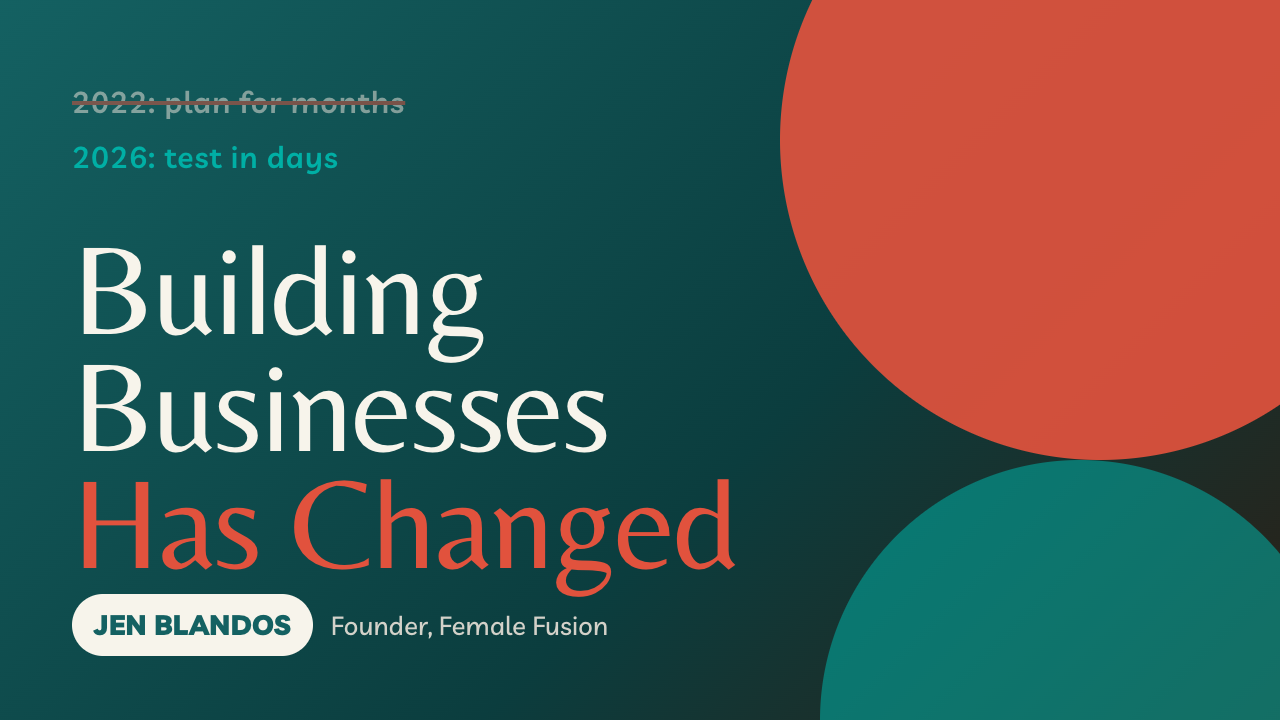
How Building Businesses Has Changed
We now move from idea to something testable faster than ever. That changes the way we build businesses.
By Jen Blandos
When I started my first business in 2002, getting an idea into the world took time. If you needed a website, you found someone to build it. If you needed a new system, you briefed someone. If you had an idea for a digital product, there could be weeks or months between thinking of it and having anything tangible enough to put in front of a customer.
That naturally affected the way we built businesses. When the first version was expensive and slow to produce, you did a lot more thinking before you made it. You researched, planned, wrote specifications, worked through budgets and tried to remove as much uncertainty as possible before committing time and money.
More than twenty years later, I do not think the fundamentals of entrepreneurship have changed. You still need to understand a real problem. You still need customers. You still need a business model that works, good judgement and the ability to execute.
But something around those fundamentals has changed dramatically: the distance between having an idea and learning something useful about it has collapsed.
Building can now be part of the research
Founders have always been told to research the market, understand their customers, study competitors and validate an idea before investing too heavily. That advice still makes sense, but we now have another way of reducing risk: we can build enough of an idea to start getting real evidence.
If a prototype takes six months and costs tens of thousands of dollars, of course you want a high level of confidence before you start. If you can create enough of that same idea in a few days to put it in front of the right people and answer an important question, the calculation becomes very different.
You can see whether people understand it. You can watch how they use it. You can learn which parts matter and which parts they ignore. You can find out whether the problem you thought was important is actually painful enough for somebody to pay to solve.
The first version does not need to prove the whole business works. It needs to help you learn what to do next.
Sometimes you build in order to understand
I have experienced this directly while building Zari, the health technology company I started after going through breast cancer treatment in 2025.
The original problem was very clear to me because I had lived it. My appointments, medications, reports, symptoms and conversations with different doctors were spread across different places. I was constantly trying to remember what had happened, work out what connected to what and make sure important information did not disappear between appointments.
The starting point was not, “I want to build a health-tech business.” It was much simpler: why is managing your own healthcare this difficult, and could there be a better way?
Once we started making the product real, our understanding of the business became much better. Users told us what they needed. Doctors looked at it differently. Investors challenged parts of the commercial model. Regulation influenced technical decisions. We began looking at the role insurers and healthcare companies could play alongside a product designed for individuals.
None of those changes meant the original idea had failed. They were how we started to understand what the business could actually become.
A useful distinction
A business is not always something you completely work out and then build.
Increasingly, you can build enough of it to help you work out what it should become.
AI has changed who can build the first version
This is the other shift I think founders should be paying attention to.
Tools such as Lovable, Replit and Claude Code mean you no longer necessarily need to assemble a technical team simply to explore whether a digital idea is worth pursuing. I have taught myself enough to create working prototypes, apps and tools in a way that would have been completely unrealistic for me a few years ago.
That does not make me a software engineer, and it certainly does not make proper technical development irrelevant. If you are building something that needs to scale, handle sensitive data, meet regulation or stay secure, experienced technical people remain extremely important.
What has changed is what you can do before you reach that point.
You can make an idea tangible enough to test the thinking behind it before committing heavily to the infrastructure underneath it.
Sometimes the experiments are very serious. Sometimes they are not. I recently built a sailing theory app for my partner and me because we were studying for a course. It was never intended to become a commercial product, but sailing clubs have since shown interest in using it. Sometimes the opportunity only becomes visible once something exists.
Start with what you need to learn
One of the most useful changes I have made in the way I approach new ideas is to stop beginning with the question, “What should I build?”
A better question is: what is the most important thing I need to find out?
Perhaps you need to know whether people understand your offer. Perhaps you want to know whether the problem is painful enough to pay for. Perhaps you need to find out whether individuals or businesses are the stronger customer. Maybe you are trying to understand which part of the product actually makes people come back.
Question One
What do I genuinely not know yet?
Avoid questions such as “Will this business work?” Get specific about the assumption that is currently holding you back.
Question Two
What is the smallest thing I could create to answer it?
It might be a prototype, a landing page, a basic app, a manual service or simply one part of the full customer journey.
Question Three
Who needs to experience it?
Find people who genuinely experience the problem, rather than people who are emotionally invested in making you feel good about your idea.
Question Four
What behaviour would tell me something useful?
A compliment is pleasant. A sign-up, payment, repeat visit, referral or request for more usually tells you considerably more.
Question Five
What would make me change my mind?
Decide this before you become too attached to the outcome. Testing is only useful if you are prepared to believe what people actually show you.
Real people are inconvenient
This is also where the process becomes uncomfortable.
The version in your head behaves perfectly. Real users do not. They click the wrong thing, misunderstand wording you thought was obvious, ignore the feature you love and ask for the thing you nearly removed.
Sometimes they tell you they love something and then never use it again. That gap between what people say and what they actually do is enormously valuable.
It is one reason why I have plugged Zari into the Living Lab at the SEE Institute in The Sustainable City. There is a big difference between discussing how people might behave and putting an idea into a real environment where you can see what actually happens.
Reality has a very useful habit of exposing assumptions.
Faster does not mean rushing
There is an important distinction here. Being able to build quickly does not mean the answer is to rush everything to market.
You can build the wrong thing extremely quickly too.
The advantage comes from shortening the cycle between making something, learning from it and deciding your next steps. You might keep going. You might change part of it. You might discover there is enough demand to start selling. Or you might stop.
Stopping is an outcome founders often underestimate.
Finding out after two weeks that an idea is not worth pursuing is considerably better than reaching the same conclusion after two years, a large team and a pile of money.
The opportunity is not simply to build faster. It is to learn faster, spend less before you know, and make better decisions sooner.
We also need to rethink how founders learn
All of this has also made me think differently about entrepreneurship events.
There is real value in hearing from people who have built interesting companies and learning from their experience. But there is a limit to how many panels any founder needs to sit through before the more useful thing becomes actually working on the business itself.
That thinking is shaping Founder Fest DXB, which we are creating with SEE Institute and Female Fusion at The Sustainable City.
The idea is to give people opportunities to build, test, get expert input, solve problems and actually move something forward. You might work on a website, prototype an app, create an AI assistant, sharpen a business offer or finally tackle something that has been sitting on your list for months. The point is not simply to leave with more notes. It is to leave further ahead than when you arrived.
Founder Fest DXB
Come and actually build something
Founder Fest DXB takes place at SEE Institute in The Sustainable City, Dubai on 14 November 2026. It is designed around doing as much as listening, with practical build sessions, experts, tools and people who can help move an idea or business forward.
EXPLORE FOUNDER FEST →The fundamentals of entrepreneurship have not disappeared. If anything, the ability to build faster makes good judgement even more important.
But founders now have access to tools that allow us to move between an idea, something tangible and real customer feedback at a speed that would have been difficult to imagine when I started my first company.
We should use that advantage.
Not to rush.
Not to build everything.
But to find out what is worth building sooner.
Entrepreneurship has changed. The way we build businesses needs to change with it.
Your Global Business Circle
Practical playbooks, weekly support, and real opportunities for women-led businesses.